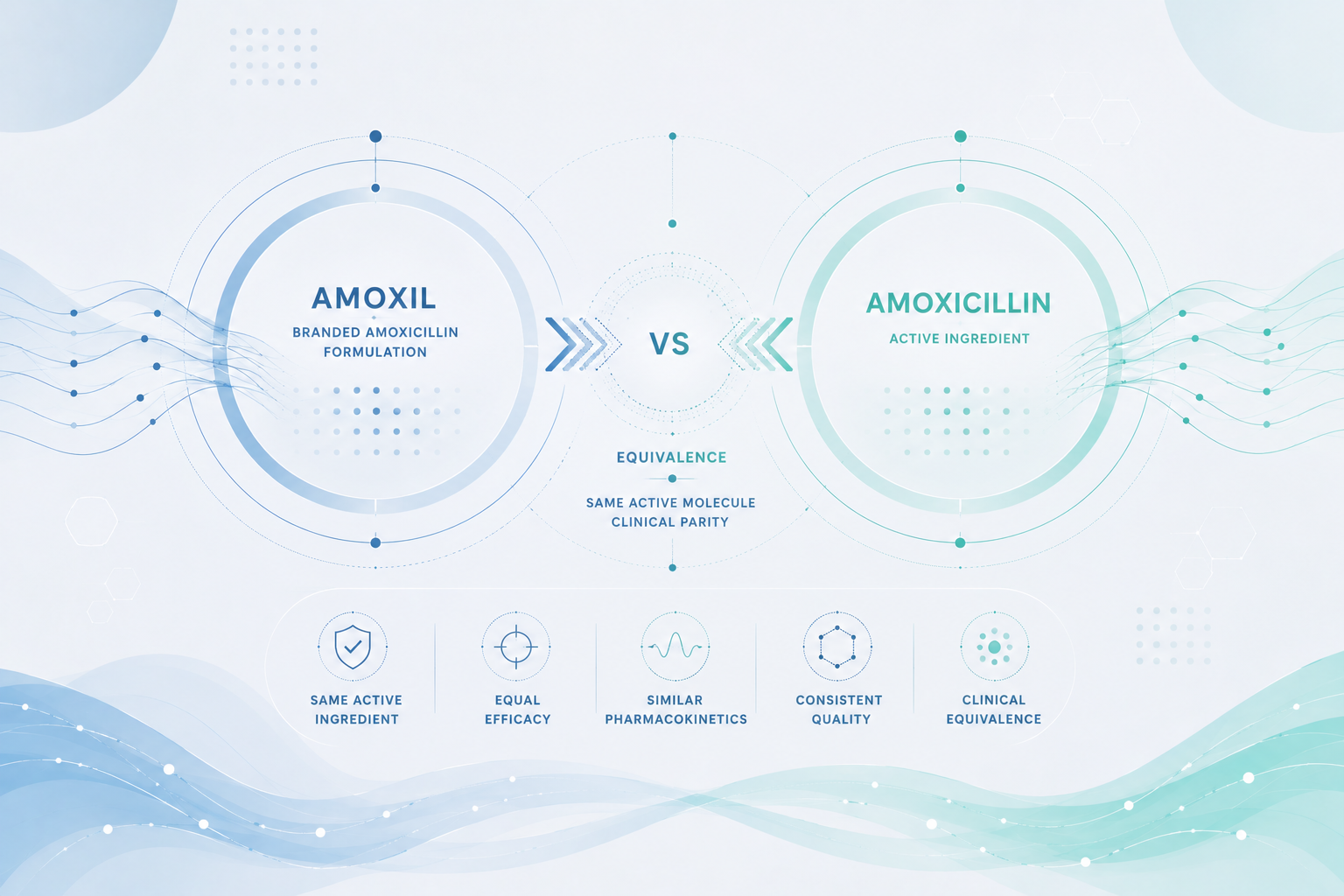
Amoxil vs Amoxicillin — Brand, Generic, Uses, Forms, Dosage, Safety, and Clinical Context
Amoxil is the branded formulation of amoxicillin, while Amoxicillin represents its generic equivalent — both
containing the identical active ingredient and delivering the same pharmacological effect. Their mechanism of
action is fully aligned: inhibition of bacterial cell‑wall synthesis through binding to penicillin‑binding
proteins, resulting in structural weakening and cell lysis. Because the core pharmacology is identical, clinical
effectiveness across ENT, respiratory, dental, urinary, and skin infections remains the same, with shared
indications including otitis media, sinusitis, bronchitis, pneumonia, skin infections, and dental infections.
Differences between Amoxil and generic Amoxicillin relate primarily to manufacturer standards, packaging,
pricing, and availability of specific formulations. Both are offered as tablets, capsules, and oral suspension,
with matching strengths — 250mg and 500mg — detailed further in Amoxil Dosages,
250mg, and 500mg. Pediatric dosing follows identical mg/kg
principles, outlined in the Pediatric section.
Safety profiles are equivalent, reflecting the established beta‑lactam class: gastrointestinal effects,
hypersensitivity reactions, and penicillin‑allergy considerations. Structured guidance is available in Amoxil Side Effects, General Side Effects, and
Interactions. For broader context on branded formulations, see Amoxil.
Amoxil is the proprietary brand name for amoxicillin, while “Amoxicillin” itself is the
international non‑proprietary name (INN) used across global pharmacopeias. Despite the
branding distinction, both products contain the exact same active ingredient and deliver
identical pharmacological action — inhibition of bacterial cell‑wall synthesis through
binding to penicillin‑binding proteins, ultimately causing structural weakening and
bacterial lysis. Because the mechanism is fully shared, therapeutic outcomes do not differ
between Amoxil and generic amoxicillin when equivalent doses and formulations are used.
The practical differences arise from non‑clinical factors: manufacturer standards,
packaging design, pricing strategy, and distribution channels. Branded Amoxil may be
preferred by some clinicians or patients due to consistent manufacturing provenance, while
generic amoxicillin is often selected for cost efficiency. These distinctions do not affect
antimicrobial potency or clinical effectiveness, making both options interchangeable in
routine care. A broader overview of branded characteristics is available in the
Amoxil overview.
In outpatient practice, both Amoxil and generic amoxicillin are prescribed for the same
indications — ENT infections, respiratory infections, dental infections, and skin
infections — with identical dosing strategies and formulation availability. This alignment
reinforces that the brand‑versus‑generic choice is primarily economic and logistical rather
than therapeutic.
Active Ingredient & Mechanism
Both Amoxil and generic amoxicillin contain the same active ingredient — amoxicillin, a
semi‑synthetic aminopenicillin widely used in outpatient antimicrobial therapy. Regardless
of branding, the pharmacological behavior is identical: the molecule inhibits bacterial
cell‑wall synthesis by binding to penicillin‑binding proteins, disrupting peptidoglycan
cross‑linking and ultimately causing structural weakening and bacterial lysis. This shared
mechanism ensures that clinical efficacy does not differ between branded and generic
formulations when equivalent doses are administered.
Amoxicillin demonstrates reliable activity against common community‑acquired pathogens,
particularly Streptococcus pneumoniae and Haemophilus influenzae, which drive many ENT
and respiratory infections. Its predictable absorption profile and broad therapeutic window
make it suitable for both adults and children, with dosing strategies adjusted according to
infection severity and patient‑specific considerations. Because the active ingredient is
identical, antimicrobial coverage and pharmacokinetics remain fully aligned across Amoxil
and generic amoxicillin.
In clinical practice, this equivalence allows prescribers to choose between brand and
generic options based on cost, availability, or patient preference rather than therapeutic
differences. Additional context on branded characteristics is available at the site root
homepage.
Forms Comparison
Amoxil and generic amoxicillin share the same core pharmaceutical forms, reflecting their
identical active ingredient and interchangeable therapeutic role. Branded Amoxil is
typically available as standard tablets, hard capsules, and oral suspension, supporting
flexible dosing across adult and pediatric populations. These formulations are designed to
provide predictable absorption and ease of administration, with tablets and capsules
commonly used in adults and suspension preferred for children or patients with swallowing
difficulties.
Generic amoxicillin mirrors these offerings — tablets, capsules, and oral suspension — and
may additionally include chewable tablets in certain markets. Chewable formulations are
particularly useful in pediatric care, offering improved adherence for children who cannot
reliably swallow solid dosage forms. Because both Amoxil and generic amoxicillin follow the
same pharmacological principles, formulation choice is driven by patient needs rather than
differences in antimicrobial activity.
Detailed descriptions of individual forms are available in dedicated sections:
Tablets, Capsules, and
Suspension. These pages outline administration guidance,
absorption characteristics, and typical use‑cases for each formulation.
Strengths Comparison
Amoxil and generic amoxicillin differ slightly in available strengths, although their core
dosing principles remain aligned. Branded Amoxil is typically offered in two standard
strengths — 250mg and 500mg — which cover the
majority of routine ENT, respiratory, dental, and skin infections. These strengths support
straightforward dosing schedules and are widely used in adult outpatient care.
Generic amoxicillin provides a broader range of strengths, including 125mg, 250mg, 500mg,
and 875mg. The expanded spectrum allows more granular dosing,
particularly in pediatric populations where weight‑based regimens require flexible
milligram increments. The 875mg strength is commonly used in high‑dose regimens for
moderate to severe infections or when enhanced coverage against resistant Streptococcus
strains is desired.
Although strength availability differs, clinical effectiveness remains identical when
equivalent total daily doses are administered. The table below summarizes the key
distinctions between branded and generic offerings.
Product
Strengths
Notes
Amoxil
250mg, 500mg
Brand
Amoxicillin
125mg, 250mg, 500mg, 875mg
Generic
Indications Comparison
Amoxil and generic amoxicillin share identical clinical indications because both contain the
same active ingredient and follow the same pharmacodynamic principles. Their antimicrobial
spectrum reliably covers common community‑acquired pathogens responsible for ENT, respiratory,
dental, and skin infections. As a result, prescribers use both products interchangeably across
routine outpatient scenarios without therapeutic distinction.
Core indications include acute otitis media, where amoxicillin
remains the first‑line option due to strong activity against Streptococcus pneumoniae.
Similarly, acute bacterial sinusitis and uncomplicated
bronchitis are routinely managed with amoxicillin‑based regimens.
Mild to moderate community‑acquired pneumonia also falls within its
established therapeutic range, particularly when pathogen susceptibility is predictable.
Beyond respiratory and ENT infections, amoxicillin is widely used for superficial
skin infections and routine dental
infections, where its absorption profile and safety record support reliable outpatient
management. Because Amoxil and generic amoxicillin behave identically in vivo, clinical
outcomes remain equivalent across all these indications, reinforcing that the brand‑versus‑generic
choice is logistical rather than therapeutic.
Pediatric Comparison
Pediatric use of Amoxil and generic amoxicillin is fully aligned because both rely on the same
mg/kg dosing principles and identical pharmacokinetics. Standard pediatric regimens typically
range from 40–45 mg/kg/day for routine infections, while severe ENT or respiratory infections
may require 80–90 mg/kg/day divided into two or three doses. These guidelines apply equally to
both branded and generic formulations, ensuring consistent therapeutic exposure across all
pediatric age groups.
Formulation availability also overlaps: oral suspension remains the
primary pediatric form due to precise mg/kg titration and ease of administration. Chewable
tablets may be available in certain markets and serve as a transitional option for children who
can tolerate solid dosage forms but still benefit from simplified administration. Detailed
pediatric guidance is provided in the Pediatric section.
The table below illustrates approximate daily and per‑dose amounts based on typical mg/kg
ranges. These values are representative and should always be adjusted according to clinical
judgment, infection severity, and patient‑specific factors.
Weight (kg)
Daily Dose (mg)
Per Dose (mg)
10 kg
400–900 mg
200–300 mg
15 kg
600–1350 mg
300–450 mg
20 kg
800–1800 mg
400–600 mg
Effectiveness Comparison
Amoxil and generic amoxicillin demonstrate identical clinical effectiveness because both contain
the same active ingredient and share the same pharmacological mechanism. Their ability to inhibit
bacterial cell‑wall synthesis through binding to penicillin‑binding proteins ensures equivalent
antimicrobial activity across ENT, respiratory, dental, urinary, and skin infections. When
administered at matching doses and intervals, therapeutic outcomes do not differ between branded
and generic formulations.
Clinical trials and decades of outpatient use consistently show that amoxicillin’s effectiveness
is determined by dose, pathogen susceptibility, and patient‑specific factors — not by branding.
As long as bioequivalence standards are met, generic amoxicillin performs identically to Amoxil
in real‑world settings. This equivalence allows clinicians to choose between the two based on
cost, availability, or patient preference rather than therapeutic considerations.
Additional context on branded characteristics, formulation availability, and dosing strategies is
provided in the Amoxil overview, which outlines how the brand fits within
the broader aminopenicillin family.
Safety & Side Effects
Amoxil and generic amoxicillin share an identical safety profile because both contain the same
active ingredient and follow the same pharmacological mechanism. As beta‑lactam antibiotics,
they commonly produce gastrointestinal reactions such as nausea, mild abdominal discomfort, and
loose stools — effects linked to alterations in gut flora rather than differences in branding.
These reactions are generally self‑limited and resolve once therapy is completed.
Hypersensitivity reactions represent the most clinically significant safety concern. Both Amoxil
and generic amoxicillin can trigger allergic responses ranging from mild rash to more pronounced
urticaria or, rarely, anaphylaxis in individuals with established beta‑lactam sensitivity.
Patients with a history of penicillin allergy should review detailed guidance in the
Penicillin allergy section before initiating therapy.
Because the active ingredient is identical, side‑effect frequency and severity do not differ
between branded and generic formulations. Structured safety notes are available in
Amoxil side effects and the broader
Side effects overview, both of which outline expected reactions,
risk factors, and management strategies.
Interactions
Drug‑interaction profiles for Amoxil and generic amoxicillin are identical, reflecting their
shared active ingredient and pharmacokinetic behavior. Both interact with anticoagulants such as
warfarin, potentially enhancing anticoagulant effect through alterations in gut flora and vitamin
K metabolism. Patients receiving warfarin should be monitored for changes in INR during therapy.
Allopurinol is another clinically relevant interaction: co‑administration may increase the risk
of amoxicillin‑associated rash, although the mechanism remains incompletely understood. Probenecid
can elevate amoxicillin serum levels by inhibiting renal tubular secretion, which may be useful in
certain therapeutic contexts but requires clinical oversight.
A complete interaction overview is available in the dedicated
Interactions section, which outlines additional agents and
considerations relevant to both branded and generic formulations.
Price & Availability
Although Amoxil and generic amoxicillin are therapeutically equivalent, their pricing and market
availability often differ. As a branded product, Amoxil is typically priced higher due to
manufacturer branding, packaging standards, and distribution agreements. These factors do not
influence clinical effectiveness but may affect patient or pharmacy preference depending on local
reimbursement policies.
Generic amoxicillin is generally more affordable and widely available across international markets.
Its lower cost reflects generic manufacturing economics rather than differences in quality or
antimicrobial potency. In many regions, generics dominate outpatient prescribing due to cost
efficiency and broad distribution.
Pricing and availability can vary significantly by country, pharmacy network, and insurance
coverage. A structured overview of cost considerations is provided in the
Pricing section, which outlines typical ranges and market‑specific
differences for both branded and generic formulations.
Amoxil vs Amoxicillin FAQ
Amoxil is the branded version of amoxicillin, while amoxicillin is the generic form.
Both contain the same active ingredient and work identically in the body. Differences
relate only to manufacturer, packaging, and pricing, not clinical effectiveness or
pharmacological behavior.
Both Amoxil and generic amoxicillin provide identical effectiveness because they share
the same active ingredient and mechanism. Clinical outcomes depend on dose, infection
type, and pathogen susceptibility rather than branding, making both options equally
reliable in routine outpatient treatment.
Yes. Dosing schedules for Amoxil and generic amoxicillin are identical because both use
the same mg‑based regimens and pharmacokinetic principles. Clinicians follow the same
frequency, duration, and total daily dose regardless of whether a branded or generic
product is prescribed.
Children can take both Amoxil and generic amoxicillin, as pediatric dosing is based on
mg/kg and applies equally to both products. Suspension and chewable forms support
flexible administration, and clinical effectiveness is identical when equivalent doses
are used.
Yes. Both products share identical side effects because they contain the same active
ingredient. Common reactions include mild gastrointestinal discomfort, rash, and
hypersensitivity in individuals with beta‑lactam allergy. Branding does not influence
the frequency or severity of these effects.
Amoxil is typically more expensive because it is a branded product with specific
packaging, manufacturing standards, and distribution agreements. These factors affect
price but not clinical performance. Generic amoxicillin is usually cheaper due to
broader production and lower branding costs.
Both Amoxil and generic amoxicillin are available as tablets, capsules, and oral
suspension. Some markets also offer chewable tablets for pediatric use. Formulation
availability is similar, and differences relate mainly to branding rather than
therapeutic function.
No. Amoxil is not inherently better for severe infections. Both Amoxil and generic
amoxicillin perform identically when appropriate doses are used. Severity determines
dosing strategy, not branding, and clinical guidelines treat both products as fully
interchangeable.
Yes. Adults can use suspension when needed, especially if swallowing tablets is
difficult or precise titration is required. Suspension provides the same therapeutic
effect as solid forms, and both Amoxil and generic amoxicillin offer identical
absorption and clinical outcomes.
Yes. Both Amoxil and generic amoxicillin can interact with warfarin by affecting gut
flora and vitamin K metabolism, potentially altering anticoagulant response. Monitoring
is typically recommended during therapy, and branding does not change interaction
behavior.
Strengths differ slightly. Amoxil typically offers 250 mg and 500 mg, while generic
amoxicillin includes additional strengths such as 125 mg and 875 mg. These differences
support flexible dosing, but clinical effectiveness remains identical when equivalent
total daily doses are used.
Amoxil may be preferred when consistent manufacturer provenance or specific packaging is
desired, but this does not affect therapeutic performance. Most patients and clinicians
choose generics for cost efficiency, as both options provide identical clinical
effectiveness and safety.